Five Ways to Use a Private Screening Room (Beyond Premieres)
When people hear screening room, they picture premiere night — velvet ropes, applause, a director fidgeting in the back row. That happens here, and it is wonderful. But most of the bookings for the screening room at Imagicomm Studios look different. Agencies, filmmakers, brands, and corporate teams use the space for work sessions and events that have nothing to do with red carpets and everything to do with seeing and hearing work the way it was meant to be experienced. Here are five ways smart teams use a private screening room — and why each works better in a theater than in a conference room.
1. Edit reviews and director cuts
Color, sound, and pacing read completely differently on a big calibrated screen than on a laptop. A shadow that looks rich on a MacBook crushes to black at scale. A music cue that felt subtle in earbuds swamps the dialogue on calibrated surround sound. Pacing problems that hide at small size become impossible to ignore when a shot lingers across a wall-sized image.
Reviewing a near-final cut in a true theater environment catches these issues before your audience does — which is exactly when you want to catch them. Post teams that build a screening pass into their finishing schedule consistently ship stronger work, because the room shows them what delivery platforms will eventually reveal anyway. It pairs naturally with a disciplined color pipeline; our piece on why color grading starts on set explains how the two connect.
2. Client presentations that land
Agencies use the room to present campaign work the way it deserves to be seen. A spot that plays on cinema sound at scale lands harder than the same file emailed as a link — not marginally harder, categorically harder. The client experiences the work the way an audience will, in a dark room with no Slack notifications competing for attention.
There is a practical persuasion layer, too. Presenting in a theater signals that the work matters and that the agency invests in how it shows up. Teams tell us approvals come faster and revision requests get smaller when clients see finished-quality presentation rather than a compressed preview on a conference room TV. For agencies producing work at our stages, pairing a shoot with a screening presentation keeps the whole cycle under one roof.
3. Focus groups and test screenings
Gather a real audience, show the work, and watch the room. Honest reactions in a controlled environment beat survey forms every time — the laugh that comes late, the shuffle during a slow second act, the silence that means attention versus the silence that means boredom. Directors and marketers alike learn more from twenty minutes of watching an audience than from a hundred emailed responses.
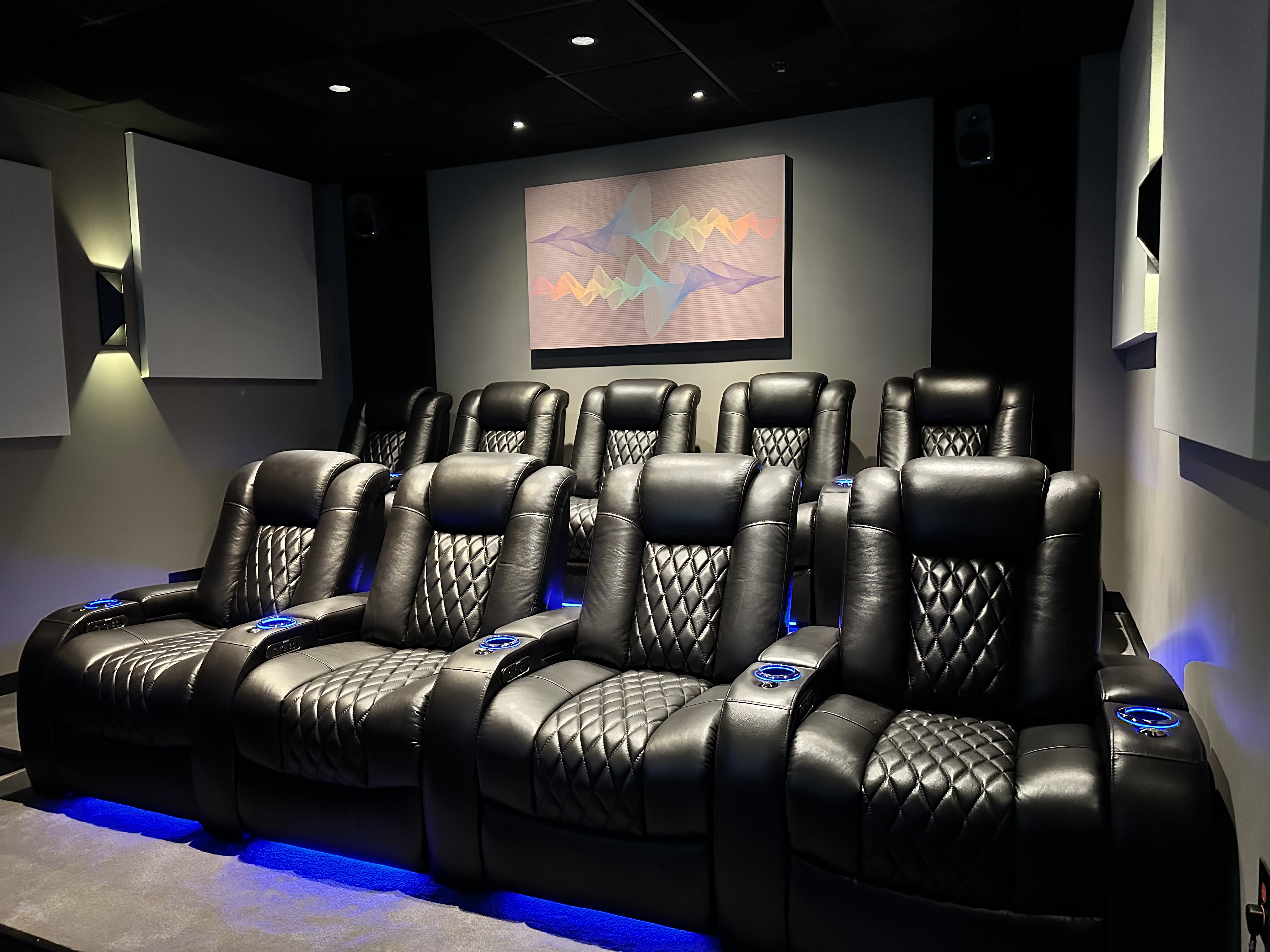
A private room with up to 40 seats hits the sweet spot for testing: large enough for genuine crowd energy, small enough to control who attends and to run a structured discussion afterward. Filmmakers use it for cut testing; brands use it to pressure-test campaigns before media dollars commit.
4. Pitches and investor presentations
Filmmakers raising financing screen sizzle reels and proof-of-concept footage for backers in a setting that says this project is real. The environment does honest work on your behalf: a potential investor watching a proof-of-concept in tiered seating with calibrated surround sound is evaluating a film, not squinting at a link on a phone.
The same logic serves startups and corporate teams pitching big initiatives. A product vision video at cinema scale, followed by a presentation in the same room, creates an event where a meeting would have been forgettable. If the pitch matters enough to rehearse, it matters enough to stage properly.
5. Team culture and watch parties
Product launches, big game nights, company milestones, wrap parties — a 40-seat theater turns an ordinary team event into one people talk about. Charlotte teams book the room for campaign launch viewings, quarterly all-hands with actual production value, and premieres of internal films that deserve better than a projector in the break room.
The practical advantages are the same ones productions value: comfortable tiered seating, a large-format screen, sound that fills the room without distortion, and free on-site parking so the event starts on time. Add catering in the adjacent spaces and the whole evening runs under one roof at 9700 Southern Pine Blvd.
Getting the most from a screening booking
- Test your playback file in advance. Send the file early or arrive ahead of guests to verify format, audio channels, and levels.
- Bring a backup copy on a second drive. Two minutes of prep insures the whole event.
- Plan the room flow. Where guests arrive, where discussion happens afterward, who controls the lights and playback.
- For reviews, appoint one note-taker so the room can watch instead of typing.
- Schedule discussion time. Book beyond the runtime — the conversation after the lights come up is usually the point of the session, and rushing it wastes the screening.
One more habit worth borrowing from experienced teams: watch the work twice. The first pass is emotional — how the room reacts. The second pass is analytical — notes, timecodes, decisions. Trying to do both in a single viewing does neither well, and the room is already booked.
Frequently asked questions
How many people does the screening room hold?
Up to 40, in comfortable tiered seating with clear sightlines to a large-format screen — right-sized for premieres, focus groups, client presentations, and team events.
Can I rent the screening room without renting a stage?
Yes. The screening room books independently by the hour, and many reservations are standalone — edit reviews, pitches, and watch parties with no production attached.
What should I bring for playback?
Your finished file on a laptop or drive, plus a backup. Tell us your format and audio configuration when you book and we will confirm compatibility before the day.
See the screening room and check availability for your next review, pitch, or premiere — or contact us to walk through an event idea. Imagicomm Studios can pair the room with our stages and green room for events that need more than a screen.
Ready to shoot in Charlotte? Check studio availability or book a tour of Imagicomm Studios.