Product Photography and Video in a Studio: Getting Shots That Sell
Shoppers cannot touch your product, so the photograph has to do the touching for them. Study after study ties product imagery quality directly to conversion rate and return rate — customers who understand what they are buying keep it. Phone cameras are remarkable, but product work that sells is a lighting discipline, not a camera feature. Here is how professionals approach it, the mistakes that flatten otherwise good products, and how to make one studio day produce months of assets for your e-commerce catalog.
Light for shape, then texture
A product photo has two jobs: show the object's form and communicate its surface. Form comes from a large, soft key light placed to rake across the product, letting gentle shadow define contours. Texture — the grain of leather, the knit of fabric, the brush of metal — appears when light skims the surface at a low angle. Flat, frontal light kills both, which is why straight-on ring-light shots look like catalog scans from 1995.
Work the light in that order: establish form with the key alone, then add a low skimming source or reposition until the texture reads, then open the shadows with white cards only as far as the mood requires. Each move should answer a question a shopper would ask — how big, how shaped, how does it feel. If a light is not answering a question, turn it off. The underlying grammar is the same three-point logic covered in our studio lighting basics guide, just applied to objects instead of faces.
The reflective product problem
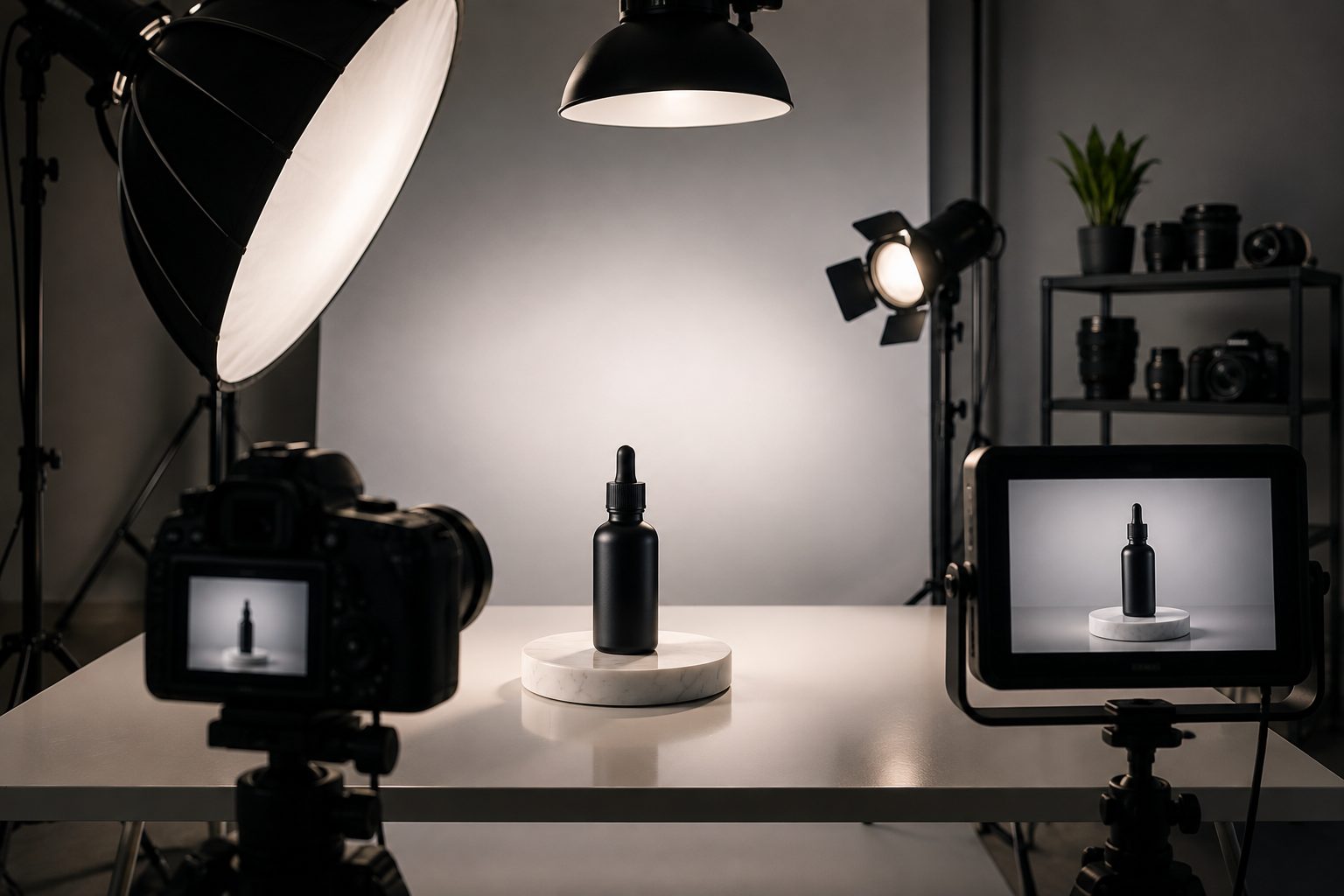
Bottles, jewelry, electronics, and anything glossy do not show light — they show reflections of the room. The professional trick is to stop lighting the product and start lighting what it reflects: large white cards, softboxes, and black flags positioned so the reflections read as clean gradients rather than a chaotic mirror of light stands. A long white gradient down a bottle's shoulder, a crisp dark edge defining a watch bezel — those are built, reflection by reflection, one card at a time. This is slow, precise work, and it is the single biggest reason reflective products belong in a studio where every surface is controllable. On location, the room is in every reflection and you cannot flag away a wall.
Consistency is a system
A store with forty products needs forty images that match — same angle, same shadow, same white. That demands a repeatable setup: marked camera position, locked lighting plot, tethered capture with an on-screen template, and a gray card for color. Build the system on product one, and product forty takes four minutes. Skip the system and your category page looks like a garage sale. Document the setup with a phone photo of the light positions and a notes file with camera settings; when you shoot the spring line in the same studio three months later, the new images will drop seamlessly beside the old ones.
Shoot video in the same session
The marginal cost of motion is small once the set is lit. Plan for each hero product:
- A slow 360 turn on a turntable for product pages
- A 15-second vertical detail pass for social and ads
- Hands-in-frame usage shots that answer "how big is it, how does it work"
Retailers consistently see video lift conversion on product pages; capturing it during the stills session is the cheapest video you will ever produce. Sequence the day so all stills are locked first, then convert the set for motion — changing direction repeatedly wastes the lighting you spent the morning perfecting. This still-plus-video approach is a cousin of the batch filming strategy: fixed setup costs, amortized across every asset you can plan in advance.
Prep that saves the day
Products arrive dusty, fingerprinted, and dented more often than anyone admits. Bring duplicates of every item, gloves, cleaning supplies, and museum wax for propping. One person on set should own styling — steaming fabric, aligning labels, hunting dust. On camera, at product-photo resolution, everything shows. Build a shot list before the day, ordered by setup rather than by product: every white-background packshot together, every lifestyle vignette together, every reflective piece in its own block. The shot list is the difference between finishing at forty products and finishing at twenty-five.
Common mistakes that flatten products
The recurring offenders: shooting on a wrinkled backdrop and planning to "fix it in post" (retouching forty backgrounds costs more than steaming one); mixing daylight from a window with studio strobes so color shifts across the catalog; using a wide lens up close, which distorts product proportions — step back and use a longer focal length; ignoring the shadow, which is half the realism of a packshot; and skipping the gray card, then spending an evening guessing at white balance. None of these mistakes require talent to avoid, only a checklist.
Frequently asked questions
Do I need a professional photographer or can my team do it?
Simple packshots on a locked setup are learnable by a careful in-house team, especially with a documented system. Reflective products, lifestyle sets, and hero campaign imagery reward a specialist. Many Charlotte brands split it exactly that way — and we can refer photographers who do product work daily.
What backdrop should I use?
Seamless white paper is the e-commerce default because marketplaces require pure white and it retouches cleanly. Colored seamless and textured surfaces suit brand and social imagery. Buy wide rolls; wrinkles and seams cost more time than paper ever will.
Why rent a studio instead of shooting in our warehouse?
Control and speed. A warehouse has forklifts, dust, mixed lighting, and interruptions; a studio has controlled light, clean power, quiet, and room to build a repeatable set. Our Charlotte studios offer controlled lighting, seamless backdrops, and the interruption-free space product work demands — Studio B at Imagicomm Studios is purpose-suited to tabletop and product photography, with the green room and kitchenette nearby for long catalog days. Whether you bring a photographer or need a referral, get in touch and turn one studio day into a season of assets.
Ready to shoot in Charlotte? Check studio availability or book a tour of Imagicomm Studios.