Corporate Video Production in Charlotte: A Complete Planning Guide
Charlotte's business community — banking, healthcare, energy, tech, and a deep bench of growing mid-market companies — produces enormous amounts of video: recruiting pieces, executive messages, training libraries, product launches, customer stories. Some of it earns attention; much of it is watched by nobody. The difference is rarely the camera. It is planning. This guide covers the decisions that determine whether your corporate video works before anyone presses record, along with a realistic timeline and the mistakes that quietly sink otherwise well-funded projects.
Start with the job the video does
"We need a video" is not a brief. Useful briefs name a viewer, a moment, and an action: a candidate deciding whether to accept an offer, a prospect comparing us to two competitors, a new hire learning a safety procedure. Every downstream choice — length, tone, talent, where it lives — falls out of that sentence. Write it first and tape it to the wall. A practical test: if two stakeholders describe the video's job differently, you do not yet have a brief, you have a future disagreement scheduled for the edit review. Resolve it now, when changing direction costs a meeting instead of a reshoot.
Script for the first ten seconds
Corporate video dies in the opening: logos, drone shots of headquarters, a slow mission statement. Audiences decide in seconds. Open with the viewer's problem or a human being saying something true and specific. Executives reading teleprompter platitudes test worse than employees speaking imperfectly about real work — authenticity is not a style, it is a strategy. When drafting, read the script aloud and time it; written corporate English runs long and stiff, and a script that reads at ninety seconds on paper often plays at two minutes on camera. For guidance on target lengths by format, see how long a marketing video should be.
Budget bands, honestly
- Efficient (single day, small crew): an interview-driven piece with b-roll, shot in a studio or one location. Most testimonial, recruiting, and executive-message videos live here.
- Standard (two to three days): multiple locations or sets, professional talent, motion graphics. Product launches and brand anthems.
- Premium: concept-driven creative with art direction and original music. Justified when the video carries a campaign.
The most common budgeting mistake is spreading money across too many videos. One strong video outperforms four mediocre ones in every metric that matters. The second most common mistake is under-budgeting post-production — editing, graphics, music licensing, and revisions routinely consume a third or more of a project, and treating them as an afterthought is how "almost done" stretches across a quarter.
Studio or on-location?
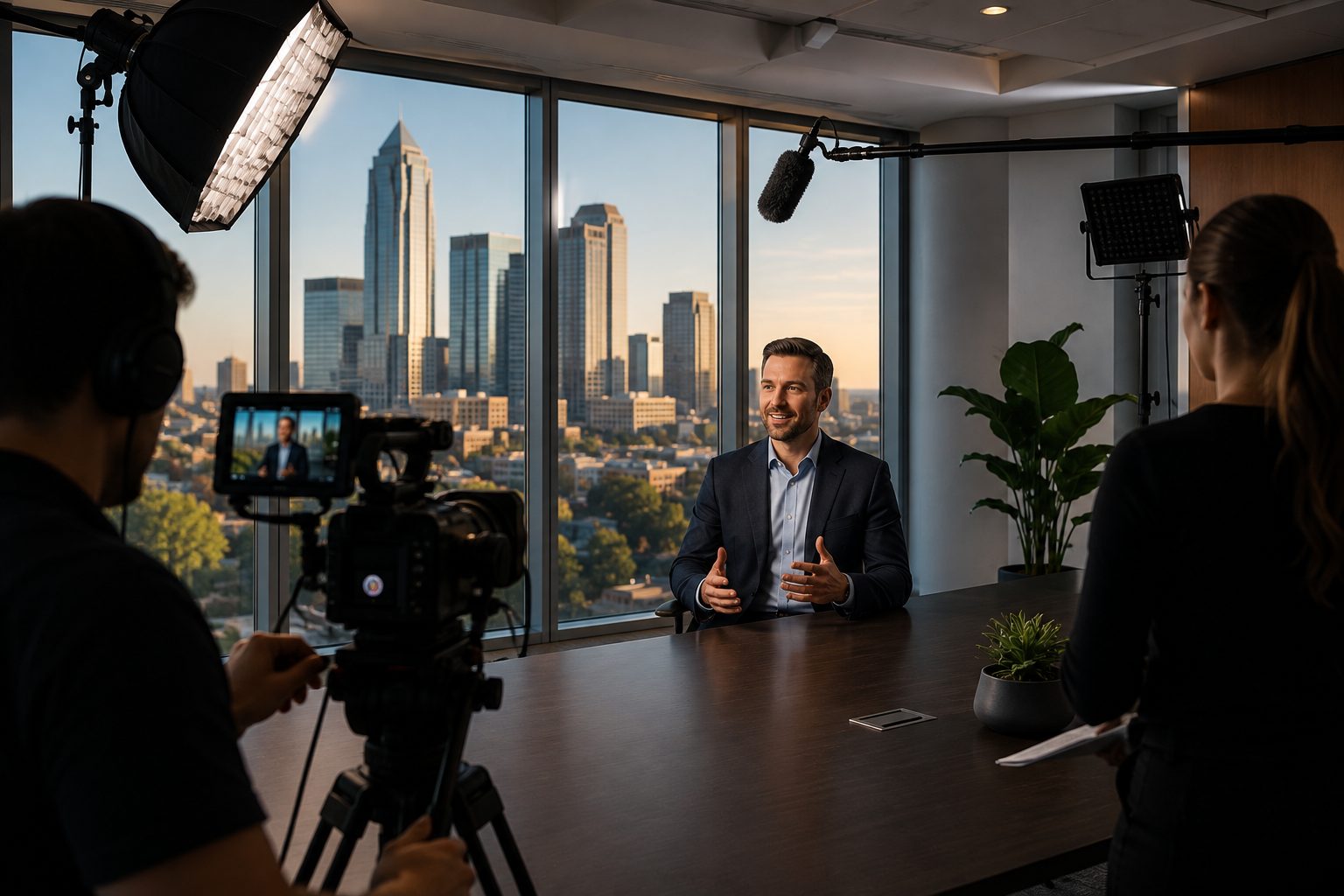
Offices photograph worse than people expect: mixed fluorescent light, echoing conference rooms, employees walking through shots, and no room for a lighting setup. A studio day delivers controlled lighting, clean audio, multiple set looks in one place, and a schedule nobody's meeting can derail. Shoot on-location when the place itself tells the story — the plant floor, the clinic, the trading desk — and in a studio when the story is people talking. Many Charlotte productions split the difference: interviews in the studio, b-roll on site. We cover the tradeoffs in depth in studio vs. location shooting. For most interview-driven corporate work, a mid-size stage like Studio B at Imagicomm Studios is the right footprint — lighting grid, sound treatment, and green room access without paying for space you will not use.
A realistic production timeline
Corporate stakeholders consistently underestimate how long good video takes. A sane schedule for an efficient-band project:
- Weeks 1–2: brief, script, and interview question development; identify on-camera participants and get calendars committed.
- Week 3: pre-production — book the studio, lock the crew, build the shot list, circulate wardrobe guidance (solid mid-tones, no fine patterns, no competitor logos).
- Week 4: shoot day. One day, tightly scheduled, with interview slots padded because executives run late.
- Weeks 5–7: edit, two consolidated revision rounds, graphics and music, final delivery in every aspect ratio you planned for.
The keyword is consolidated revisions: one stakeholder collects all feedback into a single list per round. Serial feedback from five reviewers is the leading cause of corporate video death.
Plan distribution before production
A video shot only in wide horizontal framing cannot become a good vertical clip after the fact. Decide during pre-production: Where does this live? What lengths and aspect ratios do we need? Who owns publishing? Capture accordingly — it costs almost nothing on shoot day and everything after. The same discipline applies to the interview questions themselves: ask each subject to restate the question in their answer, and you will walk away with modular soundbites that cut cleanly into a hero video, social clips, and recruiting snippets from a single session.
Frequently asked questions
How much does corporate video production cost in Charlotte?
Market rates vary widely with crew size and finishing, but interview-driven single-day projects generally land in the low five figures all-in, while multi-day campaign work scales well beyond that. Studio rental is typically one of the smaller line items — crew and post-production drive most of the budget. Our article on studio rental costs in Charlotte breaks down the facility side.
Should we hire a production company or build in-house?
For recurring content (social, training, internal comms), in-house teams win on speed and cost. For flagship pieces where polish carries the brand, experienced crews earn their rate. Many Charlotte companies run both: an internal creator for cadence, hired specialists for campaigns — often sharing the same rented studio.
How do we get nervous employees to be good on camera?
Interview them, do not script them. Send questions ahead, but ask for stories rather than statements on the day. Shoot in a calm, private studio rather than a fishbowl conference room, keep the crew small during takes, and record more than you need — the tenth minute is always better than the first.
When you are ready to scope a project, talk to our team. Our Charlotte studios host corporate shoots weekly, and we can connect you with proven local crews who make shoot days calm instead of chaotic.
Ready to shoot in Charlotte? Check studio availability or book a tour of Imagicomm Studios.