Studio vs. Location: Where Should You Shoot Your Next Project?
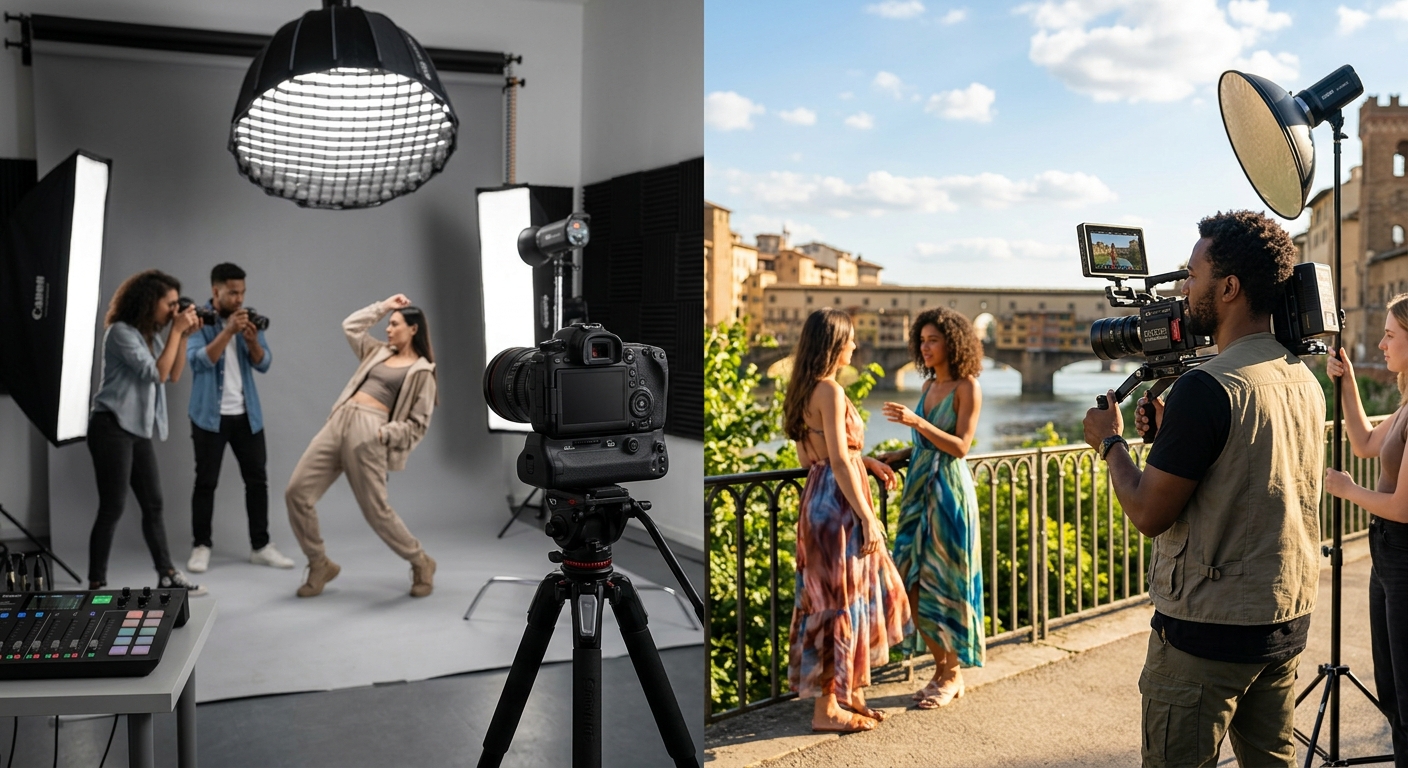
Every producer faces this call eventually: build it in a studio or chase it on location? Both can be right, and both can quietly wreck a budget when chosen for the wrong reasons. Location shoots look tempting on paper — the space already exists, the backdrop is free, the authenticity is built in. Then the weather turns, the permit office goes quiet, and a leaf blower starts up outside the window during your best take. Here is an honest comparison to help you choose, plus the hybrid approach many Charlotte productions land on.
The case for the studio
Control. No weather, no traffic noise, no sun moving across your key light. You own every variable from call to wrap. That control compounds: when nothing unexpected eats twenty minutes, your shot list actually survives contact with the day. Crews consistently get more usable setups per hour on a stage than in the field, and directors get the takes they want instead of the takes the environment allowed.
Sound. Treated stages deliver clean dialogue without the HVAC hum, leaf blowers, and flight paths that haunt location audio. Bad location sound is the most expensive problem in post-production — ADR sessions, dialogue repair, or simply living with audio that undercuts an otherwise strong piece. On a sound-treated stage, what the boom hears is what you ship.
Power and rigging. Real power distribution and a proper overhead grid mean faster setups and safer sets than running stingers through a rented house and hoping the breaker panel cooperates. Rigging from a grid instead of floor stands also clears the floor, which speeds up camera moves and keeps walk paths safe.
Predictable cost. One invoice, no permits, no location fees, no neighbor negotiations, no scramble for restrooms and parking. When you book a stage at Imagicomm Studios, the number on the quote is the number on the invoice.
The case for location
Authenticity. Some spaces cannot be faked on a budget — a working commercial kitchen, a stadium, an uptown Charlotte skyline, a client's actual factory floor. When the environment is the story, go get the environment.
Scope. If your story needs ten different environments in one day of b-roll, driving beats building. No stage rental competes with the variety a scout van can cover between sunrise and sunset.
Found production value. A great location arrives pre-dressed. Architecture, texture, depth, and practical lighting that would cost thousands to fabricate are simply there, free with the location fee.
The honest math
Here is where the comparison usually flips. Location fees, permits, insurance riders, generator rentals, portable restrooms, parking logistics, and weather contingency days add up quickly — and several of those costs are invisible until you are deep into prep. A location that costs nothing to look at can cost more than a stage day by the time it is actually shootable.
Run a quick worked example. An interview shoot at a borrowed office: free space, but add a half day of furniture moving, unpredictable HVAC noise, mixed lighting you must fight, and a hard out at 5 p.m. The same shoot on a mid-size stage in Charlotte runs $100 to $150 per hour with a grid, clean power, treated sound, and no restoration. Price the true totals, including crew hours lost to environmental problems, and the studio day often wins — especially for interviews, product work, and dialogue scenes. For a fuller breakdown of stage pricing, see our guide to film studio rental costs in Charlotte.
Questions that make the decision for you
- Is sound critical? Dialogue, interviews, and podcasts push hard toward the stage.
- Is the environment the point? If viewers must recognize or believe the place, scout it.
- How tight is the schedule? Weather days and permit timelines punish tight deadlines; stages do not.
- What does the background need to be? A seamless white or colored void means a cyc wall, full stop — see what a cyc wall does.
- Who is coming? Clients and executive talent are far happier in a facility with a green room, parking, and coffee than on a sidewalk next to a generator.
Common mistakes on both sides
The classic location mistake is scouting with your eyes and not your ears. Visit at the same time of day you will shoot, stand quietly for five minutes, and listen. Traffic patterns, flight paths, and neighboring businesses reveal themselves quickly.
The classic studio mistake is under-designing the frame. An empty stage is a blank canvas, and blank canvases photograph as exactly that. Budget for set dressing, foreground elements, and background depth — even a modest art department budget transforms a stage shoot. Our piece on set design on a budget shows how far a few hundred dollars goes.
The hybrid answer
Many Charlotte productions split the difference: exteriors, establishing shots, and environment-driven b-roll on location, and everything sound-critical — interviews, dialogue, product coverage — on the stage. You get the authenticity where the audience sees it and the control where the audience hears it. Scheduling the stage day first also gives you a weather-proof anchor: if the location day slips, the project still has its spine.
Frequently asked questions
Is a studio always more expensive than a location?
No. Once you add permits, location fees, insurance riders, and contingency days, mid-size stage rentals are frequently the cheaper total — and almost always the cheaper cost per usable setup.
Can a studio really replace a location look?
Often, yes. Set builds, cyc backgrounds, and controlled lighting cover a huge range of looks, and green screen or virtual backgrounds extend that further for the right projects.
What should I do if my project needs both?
Book the stage day first as your anchor, schedule locations around it, and keep sound-critical scenes on the stage. Tell the studio your full plan — good facilities help you think through the split.
Weighing options for an upcoming project? Talk to the Imagicomm Studios team — we are happy to help you think it through, even if the answer turns out to be a location.
Ready to shoot in Charlotte? Check studio availability or book a tour of Imagicomm Studios.