Green Screen vs. Virtual Production: Which Is Right for Your Project?
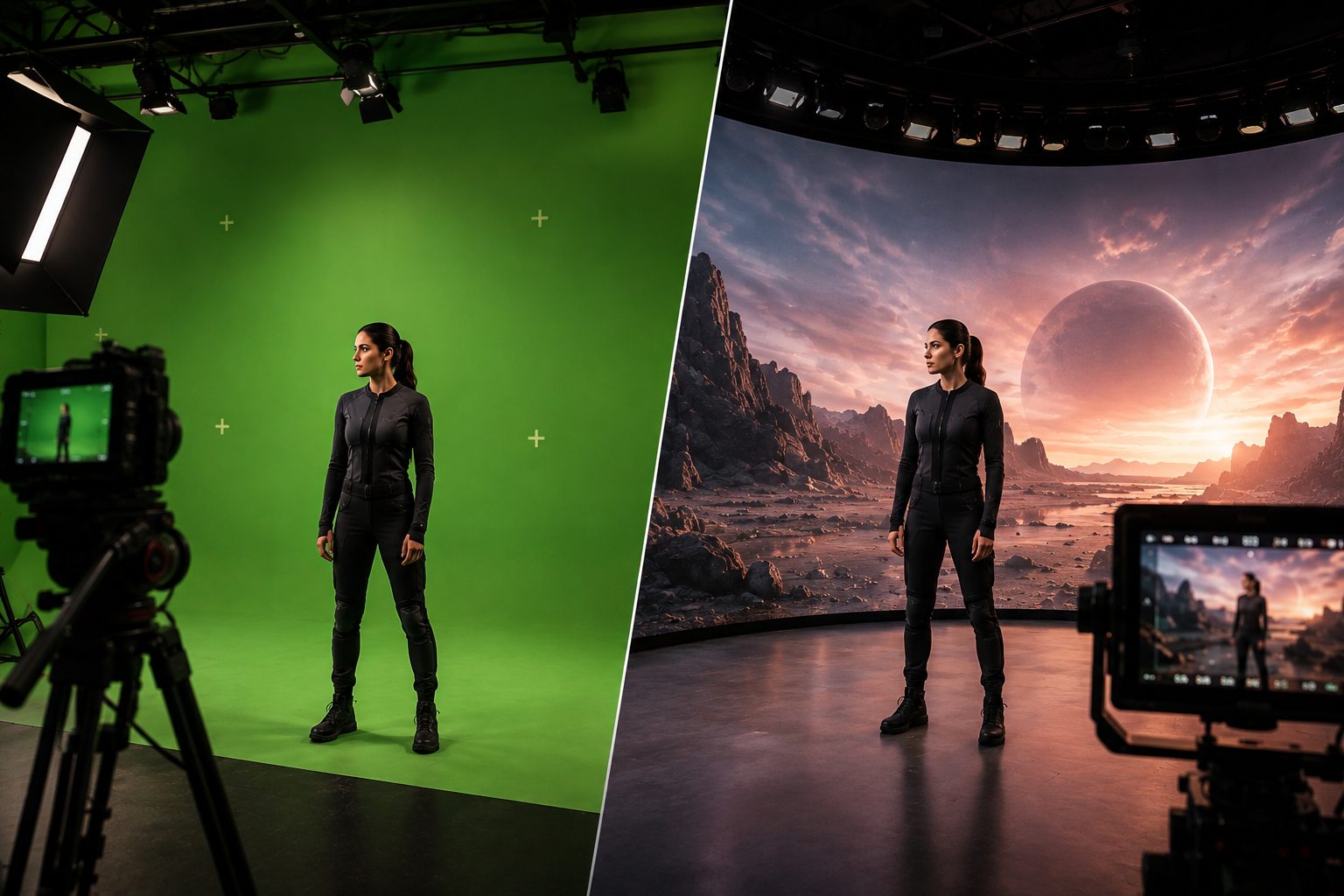
Every producer eventually faces the question: shoot the background for real, key it in later, or render it live? For decades, green screen was the default answer whenever the location you needed was impossible, expensive, or imaginary. Today, LED-wall virtual production — the technique made famous by large streaming productions — is trickling down to commercial and corporate work. Both approaches have a place, and choosing correctly can save you thousands of dollars and days of post-production. This guide walks through how each technique actually works, where each one fails, and a practical framework for deciding which belongs on your next Charlotte shoot.
How green screen actually works
Chroma keying removes a specific color — usually green, sometimes blue — from your footage so another image can be placed behind your subject. The concept is simple; the execution is where projects succeed or fail. A clean key demands three things: an evenly lit backdrop with no hot spots or shadows, enough separation between subject and screen to avoid green spill on skin and clothing, and a camera that records enough color information (4:2:2 or better) for the keyer to find crisp edges.
Each of those requirements has a practical consequence on set. Even lighting means dedicated fixtures on the screen itself, metered corner to corner, completely separate from the lights on your talent. Separation means at least six to ten feet between subject and backdrop, which rules out cramped rooms. And color depth means choosing a recording format before the shoot, not discovering in the edit that your footage keys like a jigsaw puzzle.
This is precisely why green screen work belongs in a studio rather than a conference room with a pop-up backdrop. A proper cyclorama wall painted chroma green, stand-off room for your talent, and a grid of controllable lights turn keying from a gamble into a routine step.
What virtual production changes
Virtual production replaces the green screen with a massive LED wall displaying your background in real time, often tracked to camera movement so perspective shifts naturally as the camera moves. The advantages are real:
- Lighting for free. The wall itself lights your talent with the color of the environment, so reflections and skin tones match the background automatically — the hardest thing to fake in a composite.
- No spill, no keying. What you see in the monitor is essentially your final frame, which shortens post-production dramatically.
- Talent performs better. Actors and executives alike respond to an environment they can see rather than a blank green void.
The trade-offs are cost and rigidity. Wall rental, media servers, and the technicians to run them price many mid-sized projects out. The background content itself must be built, tested, and color-matched before the shoot, which adds weeks of pre-production most commercial timelines do not have. And once you are on the wall, changing the background means changing the content pipeline — not simply swapping a plate in editing.
Where green screen goes wrong
Most failed keys trace back to a handful of preventable mistakes. Talent wearing green or reflective clothing. Subjects standing too close to the screen, picking up spill on shoulders and hair. Wrinkled fabric backdrops casting micro-shadows the keyer reads as edges. Motion blur from fast movement smearing green into the subject. And mismatched lighting — a subject lit warm and soft composited into a background that is clearly cool and hard reads as fake to every viewer, even those who cannot say why. Solving the last problem means planning your background before the shoot so your gaffer can light the foreground to match. Good lighting fundamentals matter more to a convincing composite than any software.
The honest decision framework
Choose green screen when your backgrounds are simple or stylized, your budget is moderate, your team has post-production capacity, and you may need flexibility to change backgrounds after the shoot. Corporate explainers, weather-style presentations, social content, and composite-heavy commercials all key beautifully with a well-lit cyc wall.
Choose virtual production when reflective subjects (cars, glass, jewelry) would betray a composite, when interactive lighting is central to the shot, or when a director needs to make in-camera decisions with the client standing beside the monitor. As a rough market reality check: an LED-wall day commonly costs several times what an equivalent green screen day does once wall rental, content creation, and specialized operators are counted, so the visual payoff needs to justify the multiple.
Many productions land on a hybrid: shoot the hero spots on a wall, then capture coverage and pickups on green screen at a fraction of the cost. The audience never notices the seam if the lighting matches.
A worked example
Consider a regional brand spot with a presenter in three environments: a stylized office, a city skyline, and an abstract product space. On green screen, that is one studio day — light the cyc once, cycle wardrobe, and swap backgrounds in post at leisure. On an LED wall, the same spot requires three finished background environments built in advance, plus wall time. If the client is undecided on the environments, green screen is the obvious call. Flip the brief to a jewelry commercial full of macro reflections, and the wall earns its cost, because a composite would have to fake every glint.
Shooting green screen in Charlotte
Video production in Charlotte has grown enough that both approaches are within reach, but for most commercial, corporate, and social work in the region, a well-run green screen day remains the best value. At Imagicomm Studios, Studio A includes a seamless cyclorama wall, a full overhead lighting grid designed for even coverage, and drive-in load access for grip trucks — plus crew referrals if you need a DP or gaffer who keys footage for a living. If you are weighing the two approaches for an upcoming project, talk to us about what your shots actually require before you commit the budget. Sometimes an afternoon of tests on a stage answers the question better than any article can.
Frequently asked questions
Do I need special cameras for green screen?
Not exotic ones, but the recording format matters. Cameras that capture 4:2:2 color or better give the keyer clean edges; heavily compressed 4:2:0 footage produces crunchy outlines around hair and fine detail. Most professional and prosumer cinema cameras qualify — confirm settings before shoot day, not after.
Green or blue screen — which should I use?
Green is the modern default because digital sensors are most sensitive in the green channel and green is uncommon in wardrobe. Blue is useful when talent must wear green, or for night-scene composites where blue spill is less objectionable.
Can Imagicomm Studios support a virtual production shoot?
Our stages are built around chroma work and traditional production, and Studio A's power distribution and load access can support brought-in LED wall packages for productions that need them. Ask early — wall vendors and technicians book well ahead, and the stage configuration should be planned around the wall footprint. Start with a walkthrough of our studios and we will help you scope it.
Ready to shoot in Charlotte? Check studio availability or book a tour of Imagicomm Studios.