
What Is a Cyc Wall — and When Do You Need One?
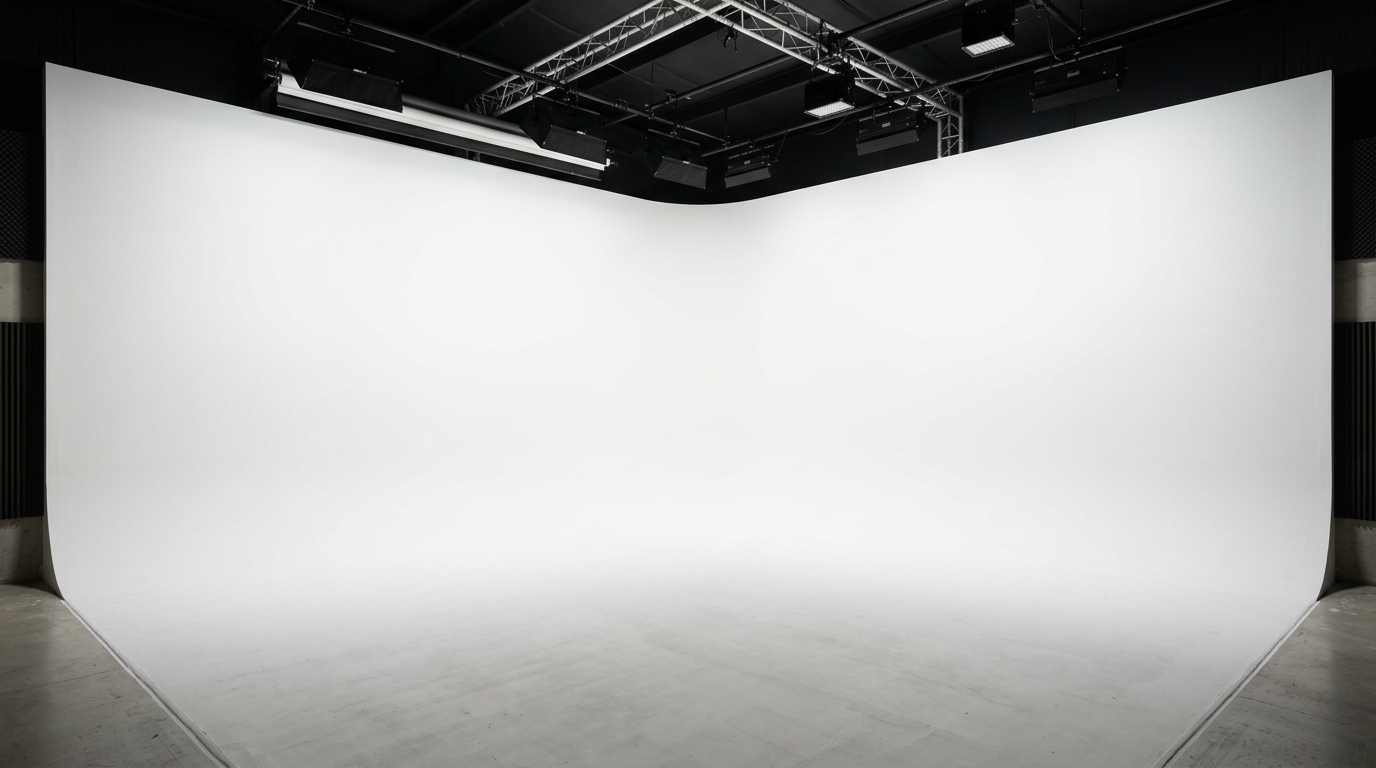
If you have seen a product floating in a seamless white void, or talent walking through a background with no visible floor line, you have seen a cyclorama wall at work. The cyc is the most requested feature in any studio, the backbone of countless commercials, fashion campaigns, and product launches — and one of the most misunderstood pieces of production infrastructure. Here is what a cyc actually is, when your project genuinely needs one, how to light it properly, and how it compares with the green screen it is often confused with.
The short version
A cyclorama — cyc for short — is a smooth, curved wall where the floor sweeps up into the vertical surface with no corner or seam. That curve, called the cove, is the entire trick: with no hard edge for the eye to grab, and lit correctly, the viewer loses all sense of depth, creating the famous infinity look. The background stops being a wall and becomes a void — white, gray, black, or any color you throw at it.
Cycs come in different footprints. A straight cyc curves only where floor meets wall. A corner cyc adds a second curved junction where two walls meet, letting you shoot wider angles and movement without ever finding an edge. Either way, the surface is plastered smooth and painted uniformly, which is why studios are protective of them — every scuff and screw hole reads on camera and costs real money to repair. Treat the cyc kindly and never tape or fasten anything to it without asking.
When you need one
Product shoots, fashion and beauty work, dance and movement pieces, automotive stills, and any concept that wants a clean, placeless background all benefit from a cyc. It is also the fastest route to a polished look on a modest budget — no set build required. You walk in, light the wall, light the subject, and shoot something that looks deliberate and expensive.
- Product and e-commerce: the seamless white background is the visual language of retail. A cyc produces it in camera at any scale, from a watch to a vehicle.
- Fashion and beauty: full-length talent with no floor line, and room for movement without the frame ever finding an edge.
- Interviews and corporate: a gray or colored sweep reads modern and intentional, and it never distracts from the speaker.
- Music videos and choreography: performers in a colored void is a look that never ages, and the cyc delivers it with lighting changes alone.
When do you not need one? If your background will be a built set, a real environment, or drapery, a standard stage wall does the job. And if the frame is tight enough — a chest-up interview, a tabletop macro shot — a nine-foot seamless paper roll can fake the look for a fraction of the cost. The cyc earns its rate when you need width, full-length framing, movement, or floor in the shot.
Lighting the cyc: the part most people get wrong
The core principle: the wall and the subject are lit separately, as two independent systems. Even top-to-bottom coverage on the cyc — usually from dedicated cyc lights or a row of soft sources — keeps the background a consistent tone, while your subject gets its own key, fill, and back light. (New to that language? Start with our three-point lighting guide.)
Evenness is the whole game on the wall. Hot spots and falloff destroy the infinity illusion faster than anything else, so lights are spaced deliberately and aimed to overlap. Then exposure sets the mood: underexpose the wall for gray tones, blast it for pure white, or gel it for color washes. One physical wall, dozens of looks, changed with dimmers instead of paint.
Two mistakes account for most bad cyc footage. First, placing the subject too close to the wall — you want enough separation that subject lighting does not splash onto the cyc and print shadows into your clean void. Second, chasing pure white by overdriving the wall until it blooms and flares into the subject's edges. White is an exposure relationship, not a brightness contest: bring the wall to roughly one to two stops over your subject exposure and stop.
Cyc vs. green screen
A cyc gives you a finished in-camera look. Green screen gives you a background you will replace in post. That single sentence settles most debates, but the details matter. If the deliverable calls for compositing — virtual environments, motion graphics behind talent — paint or light the cyc green and key it out later. If the deliverable is the clean sweep itself, shooting it for real usually gets you to final faster and cheaper, with no keying artifacts, no spill correction, and no VFX line in the budget.
There is also a performance argument: talent and directors compose better against a real visible background than against a green rectangle and imagination. For a deeper comparison, including where virtual production fits, see green screen versus virtual production.
Booking a cyc shoot in Charlotte
Cyc stages sit at the top of the studio market because the wall itself is expensive to build and maintain — in Charlotte, expect large cyc stages to start around $150 per hour, as covered in our studio cost guide. When booking, tell the studio your subject, framing, and whether you need white, a color, or green; that determines the lighting package and how much pre-light time to schedule. Budget real time for the pre-light: an evenly lit cyc is a craft task, not a switch flip.
Frequently asked questions
What does cyclorama mean?
The term comes from theatrical backdrops — large curved curtains suggesting sky or infinite space behind a stage. Film studios borrowed the idea and made it a permanent plastered wall.
Can I stand or roll equipment on the cyc floor?
The flat floor area, yes — talent and dollies work on cycs constantly. The curved cove is the fragile part: keep stands, feet, and wheels off it, and ask the studio about protection for heavy loads.
Can one cyc produce both white and colored backgrounds?
Yes. A white cyc becomes gray through underexposure and any color through gelled or LED cyc lights. That flexibility is precisely why the wall is so requested.
Studio A at Imagicomm Studios features a full seamless cyc with a production lighting grid, sound-treated construction, and drive-in load access for larger builds. Take the 360° tour, or talk to our team about pre-lighting the wall before your call time.
Ready to shoot in Charlotte? Check studio availability or book a tour of Imagicomm Studios.